
Imagine the moment your loved one is finally cleared to leave the ward, only for that relief to be replaced by a sudden wave of worry about managing their recovery at home. You might feel exhausted from balancing work with care or confused by complex medication schedules and new equipment needs. In November 2025 alone, over 291,000 bed days were lost in England because the right support wasn’t ready for patients to leave. Choosing professional hospital discharge support services ensures that your family member doesn’t become another statistic and instead receives the specialised care they deserve in familiar surroundings.
We understand that you want nothing more than a safe, dignified return to independence for your relative. This guide will show you how tailored support can prevent the fear of readmission and provide total peace of mind for the whole family. We’ll walk you through the essential elements of a successful transition, including professional help with mobility and medication management, so you can focus on being a family again.
Key Takeaways
- Understand the vital role of hospital discharge support services as a bridge between the clinical ward and your loved one’s independence at home.
- Learn the difference between standard and complex discharge assessments to ensure your relative receives the correct level of care immediately.
- Discover how professional medication management and mobility assistance significantly reduce the risk of accidents and hospital readmission.
- Explore how person centred recovery plans are tailored to specific health conditions to promote a faster and more comfortable recuperation.
- Find out how to access responsive care teams across West and North London including areas like Ealing and Chiswick for a seamless transition home.
Navigating the Hospital Discharge Process and the Need for Professional Care at Home
Professional hospital discharge support services act as a vital bridge between the clinical environment of a hospital ward and the independence of life at home. Transitioning back to a familiar setting is often the highlight of a patient’s recovery journey; yet it’s also a period fraught with risk. Whilst most patients experience an immense sense of relief when they finally see their own front door, this is frequently shadowed by quiet anxiety about how they will cope without the constant presence of nurses.
This transition can be even more complex if a patient is currently abroad. For families coordinating a return to the UK, RN MEDflights offers professional clinical assistance on scheduled flights, ensuring their loved one arrives safely to begin their home-based recovery.
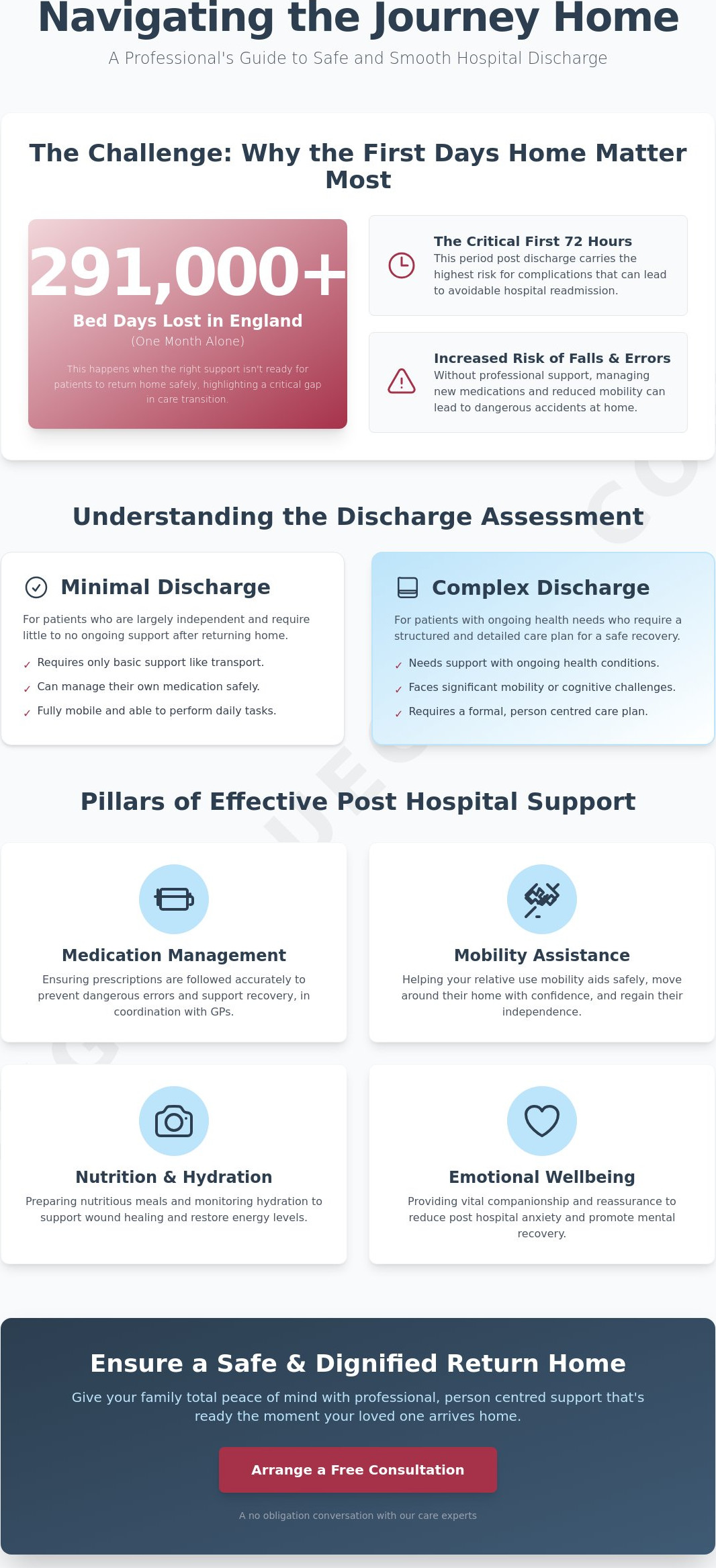
The distinction between a minimal discharge and a complex discharge assessment is significant. A minimal discharge usually involves patients who require little more than their medication and transport home. In contrast, a complex discharge assessment is necessary for those with ongoing health needs, mobility issues, or cognitive challenges like dementia. Effective discharge planning for patients ensures that every detail is considered before the hospital doors close behind them.
Research shows that the first 72 hours after leaving the ward are the most critical for preventing readmission. During this window, the risk of medication errors or falls is at its highest. In November 2025, over 291,000 bed days were lost in England due to delayed discharges, often because families felt unready to manage the transition alone. Having professional hospital discharge support services in place provides a safety net that protects your loved one during these fragile first few days.
The Role of the Discharge Assessment
During a pre discharge review, a ward manager or social worker evaluates the patient’s ability to perform daily tasks safely. They look at mobility, cognitive function, and the home environment to determine what level of assistance is needed. Family members have a right to participate in these care plan discussions to ensure the proposed support matches the reality of daily life. The care plan is a vital document that serves as a roadmap for a successful home recovery.
Identifying When Private Support is Necessary
Standard local authority care packages are often limited by strict time slots and may not cover complex needs or companionship. Many families find that a dedicated private carer offers a level of responsiveness that the public system cannot always match. Having a professional carer ready at the front door the moment your relative arrives home ensures that the kettle is on, the house is warm, and medication is organised immediately. This proactive approach builds confidence and allows the patient to focus entirely on getting better.
Key Elements of Effective Hospital Discharge Support Services for Seniors
Once the threshold of the home is crossed, the focus shifts from clinical stability to functional recovery. Professional hospital discharge support services provide the structure needed for this change, ensuring that the recovery plan isn’t just a piece of paper but a lived reality. According to the Official government guidance on hospital discharge, the priority is to get patients into the right setting to assess their long term needs. At home, this means managing everything from housekeeping to complex medication schedules.
Medication and Mobility Management
Managing new post surgery medications can be overwhelming for seniors and their families. Carers work closely with GPs to ensure prescriptions are followed accurately, preventing dangerous errors. Alongside this, mobility assistance is vital. A carer ensures that mobility aids are used safely, helping your relative move around their home with confidence. This support often transitions into ongoing personal care for elderly at home to maintain independence.
Nutrition and Emotional Wellbeing
Proper nutrition is essential for wound healing and restoring energy levels after a hospital stay. Carers provide meal preparation and hydration monitoring, ensuring your loved one receives the nutrients they need to heal. Beyond physical health, companionship plays a huge role in recovery. Having someone to talk to reduces the post hospital blues and provides emotional reassurance. If you are unsure about the level of help required, you can speak with our care coordinators today to explore your options.
By taking care of housekeeping and laundry, effective hospital discharge support services allow the patient to focus solely on rest. This comprehensive approach creates a calm environment where recovery can truly flourish.
Accessing Personalised Post Hospital Care in West and North London
Choosing the right provider is a decision that impacts the entire family. Angelique Care provides hospital discharge support services that focus on the individual rather than just the condition. We create person centred recovery plans that adapt to your loved one’s unique needs. As a CQC registered provider, we adhere to high standards of safety and clinical excellence. Our family focused approach ensures that relatives stay informed of every recovery milestone achieved at home.
We follow the UK Government Hospital Discharge Guidance to ensure every transition is safe and efficient. Our local care teams are highly responsive across West and North London. We provide dedicated support in areas like Ealing, Acton, and Chiswick. This local presence allows us to be there quickly when you need us most.
Specialist Support for Stroke and Surgery Recovery
Recovery from a stroke or major surgery requires a disciplined yet gentle approach. We integrate specific exercises and routines into the daily care schedule to help restore mobility. Our carers understand the patience needed for rehabilitation. For more detailed advice on this topic, please see our home care for stroke recovery guide. We focus on restoring dignity alongside physical strength.
Starting Your Care Journey in London
Beginning the process is simple and stress free. We offer a free consultation to assess home needs and answer your questions. Support can be organised quickly even for emergency discharges where time is of the essence. You don’t have to face this transition alone. Our team is ready to help you navigate the path from hospital to home with confidence and care.
Securing a Safe and Confident Return Home
Returning home after a hospital stay should be a time of healing and renewed hope rather than a period of stress. We have explored how professional hospital discharge support services provide the essential safety net your loved one needs during those critical first 72 hours. By focusing on expert medication management and mobility assistance, you can significantly reduce the risk of accidents and help your relative regain their independence with dignity.
As a CQC registered provider and specialists in dementia and elderly care, Angelique Care has served families across West and North London for years. We understand the unique challenges of post hospital recovery and are here to provide the person centred support your family deserves. Whether you need immediate help for an emergency discharge or are planning for a scheduled surgery, our local teams are ready to assist. Take the first step towards a smooth transition today.
Contact Angelique Care for a free consultation on hospital discharge support and discover how we can help your loved one recover comfortably in their own home. You don’t have to manage this journey alone.
Frequently Asked Questions
What is included in a hospital discharge assessment?
A hospital discharge assessment evaluates your loved one’s physical health, cognitive ability, and home safety to ensure they can leave the ward safely. It includes a review of mobility needs and a check of the home environment for potential hazards. This process involves ward managers and social workers who create a document known as a care plan to guide recovery. This assessment determines whether a simple discharge is possible or if more complex support is required.
Can hospital discharge support services help with medication?
Yes, hospital discharge support services include comprehensive medication management to ensure all prescriptions are followed accurately. Carers help with organising dosages and monitoring for any side effects whilst keeping your GP informed of progress. This professional oversight reduces the risk of errors which are common during the first few days back at home. Our staff are trained to handle complex medication schedules with clinical precision and heartfelt care.
How soon can home care start after leaving the hospital ward?
Home care can often start on the same day your relative is discharged or within 24 hours of your initial request. We understand that hospital departures can be unpredictable and sometimes occur with very little notice. Our local teams in West and North London are structured to be responsive and can often organise support for emergency discharges quickly. This ensures there is no gap in care during the critical transition period when support is most needed.
What happens if my loved one needs care during the night?
If your family member requires assistance during the hours of darkness, we provide specialised night care options such as waking nights or sleep in support. A waking night carer remains alert throughout the night to assist with mobility or medication. For those requiring constant presence, live in care is also an effective solution to ensure safety and comfort around the clock. We adapt these services to match the specific needs identified in the person centred recovery plan.